
Dean Nancy Messonnier on what ‘take care’ means in public health: building trust, expanding possibilities and helping communities thrive across generations.
For many of us, “take care” is something we say almost automatically.
It’s how we sign an email. It’s the last thing we say before hanging up the phone. It’s a small expression of goodwill and a wish for others to be well.
But in public health, “take care” carries deeper meaning. It’s not only a personal sentiment; it’s a collective responsibility. To take care is to look beyond ourselves and ask what people need to thrive — not just today but across lifetimes and generations.
“Take care” carries deeper meaning. It’s not only a personal sentiment; it’s a collective responsibility.
At the UNC Gillings School of Global Public Health, taking care means strengthening the systems that support health and well-being for all. It means building trust, expanding possibilities, and ensuring communities have the knowledge and resources they need to live healthier lives.
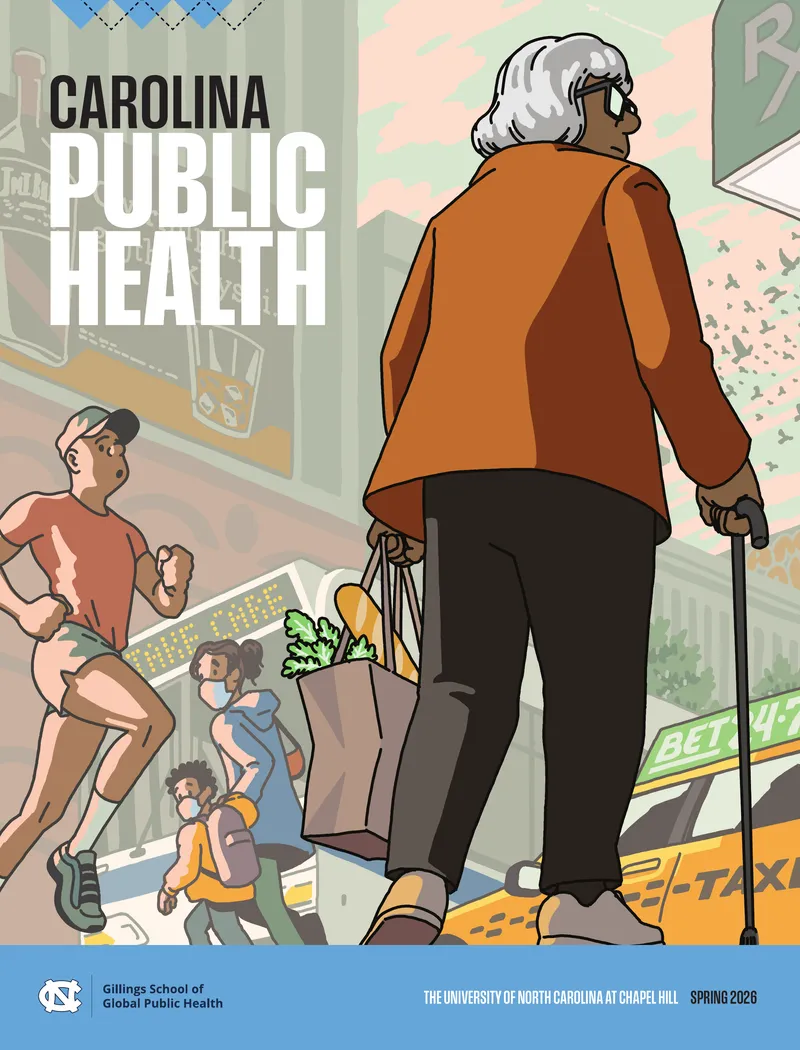
In this issue of Carolina Public Health, you’ll see many examples of what that commitment looks like in practice.
Some of this work begins with trust — a foundational element of public health that has never been more important. Our faculty are examining how trust is built and sustained (and sometimes lost), and how we can strengthen the relationships between communities, health systems and public health institutions.
In one story, you’ll travel to Burke County, North Carolina, where the Gillings School and local community organizations are collaborating on street medicine. By meeting people who are unhoused in the places where they spend their days, providers are able to deliver essential care earlier and more consistently. This approach improves the health of individuals who too often fall through the cracks of traditional systems while reducing strain on emergency departments and hospitals. It’s a powerful reminder that when care reaches the people who need it most, entire communities benefit.
Other stories highlight how we care for communities across the lifespan. From improving cancer screenings and promoting healthy nutrition for athletes, to supporting an aging population with innovative research and policy solutions, our faculty and students are advancing science that helps all people live longer, healthier lives.
Of course, taking care also means preparing and supporting the next generation of public health leaders. For a school of public health, education is one of the most powerful ways we can strengthen the future of our field.
In a time of rapid technological change, our faculty members are exploring how tools like artificial intelligence can enhance teaching and learning while we preserve the critical thinking and human connection that define public health research and practice.
And in the face of evolving funding challenges that are affecting public health nationwide, we remain committed to supporting our students and alumni — ensuring they have the tools, mentorship and connections they need to continue their important work in communities across North Carolina and around the world.
Public health, at its core, is about the conditions that allow people to not just survive but flourish.
This is reflected in our faculty feature on ensuring safe water access in maternity hospitals so both parents and newborns can experience a healthy start. It is there when a researcher works to prevent alcohol overuse among students so that young people can thrive during a formative time in their lives. It is the reason we strengthen communities: so that health is not a privilege but a shared foundation.
These efforts remind us that care is not abstract. It is built through policies, programs, research and relationships that shape the environments where people live, learn, work and play.
In a world facing complex and interconnected health challenges, the mission of public health is clearer than ever. We must continue to work together — across disciplines, sectors and borders — to ensure everyone has the opportunity to live a healthy life.
That work is not always easy, but it is profoundly meaningful.
So when we say “take care” to one another, we are expressing more than a farewell.
We are naming the purpose that unites our School and our field: a commitment to care for one another, to care for our communities and to build a healthier future for all.
Please do take care.
Dr. Nancy Messonnier
Dean and Bryson Distinguished Professor in Public Health
UNC Gillings School of Global Public Health