
Connecting with communities to improve public health
Mackenzie Christensen, Dr. Makala Carrington, Dr. Melissa Haithcox-Dennis and Dr. Kim Ramsey-White attend the Interfaith America Leadership Summit.
Two Gillings programs, the Carolina Health Collective and Practice-in-Place, answer eroding public trust with listening, dialogue and community partnerships.
Public trust in science and public health is under strain. Shaped by political polarization, misinformation and real frustrations with how health institutions engage communities, this erosion of trust disproportionately harms communities that already feel unheard, limits the uptake of evidence-based solutions and weakens public health impact.
Carolina Health Collective
Led by Gillings School faculty Lindsey Smith Taillie, PhD, professor of nutrition, and Karl Johnson, PhD, assistant professor of public health leadership and practice, the Carolina Health Collective is a cross-campus initiative designed to strengthen connections across diverse communities, policymakers and public health practitioners to rebuild trust and address pressing public health challenges. This initiative is grounded in the belief that rebuilding trust demands humility, honest dialogue about where public health has fallen short and more meaningful engagement across political, ideological and cultural divides. By integrating expertise across public health, communications, policy and civic discourse, the Carolina Health Collective aims to position UNC as a national leader in civic-engaged public health.
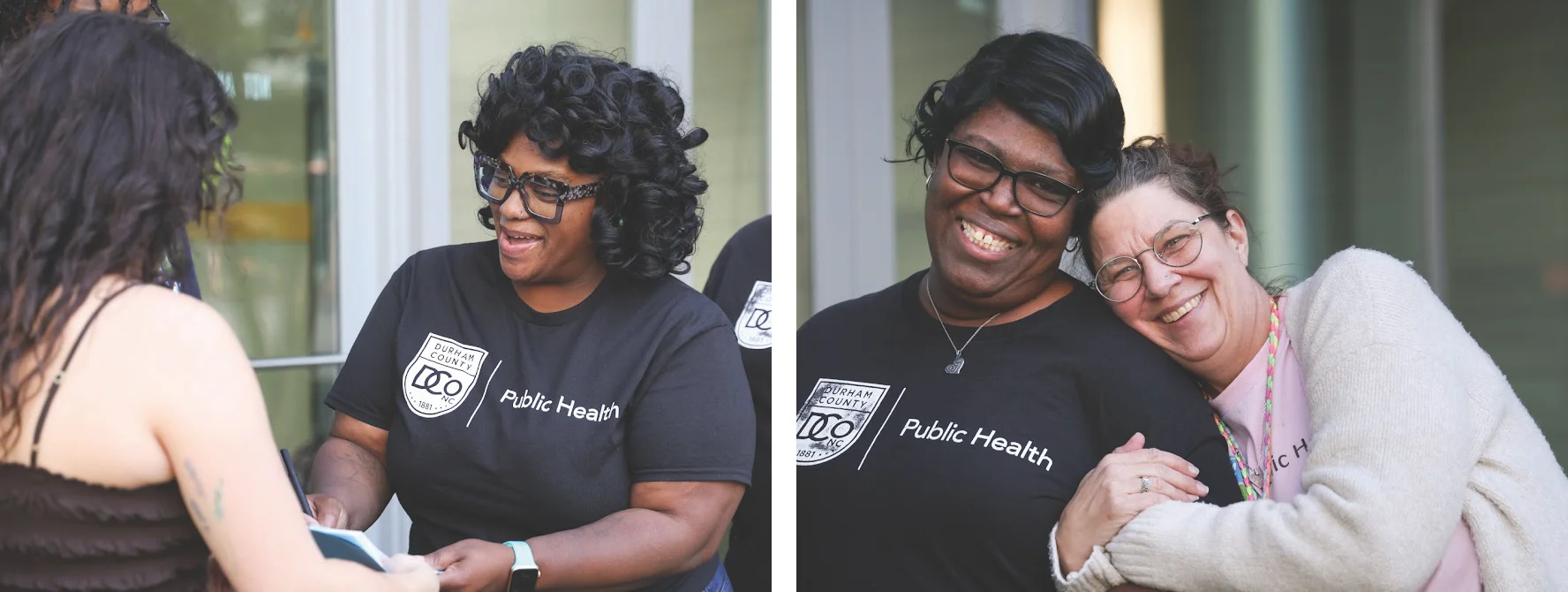
The Collective has identified four pillars to support their approach:
- Listening to and partnering with diverse communities (community engagement),
- Actively translating public health science to communities (communication)
- Training students on effective advocacy and policy (policy engagement), and
- Fostering honest discussion about the health challenges shaping our future (public discourse).
This year, the Collective is leading several listening and discussion events across campus, developing several new cross-school courses, and supporting student practicum opportunities.
Practice-in-Place
These efforts reflect a broader commitment at Gillings to strengthening community-engaged public health practice. Alongside the Carolina Health Collective, Practice-in-Place offers another model for translating that commitment into sustained partnerships with communities across N.C. Through Practice-in-Place, students build relationships with community organizations and apply their public health skills in ways that respond directly to community-identified priorities.
This initiative is grounded in the belief that rebuilding trust demands humility, honest dialogue about where public health has fallen short and more meaningful engagement across political, ideological and cultural divides.
This summer, students from the Gillings School took their learning beyond the classroom through Practice-in-Place, a community-engaged practicum experience developed through the Gillings Public Health and Faith Communities Initiative. Supported by a Faith in Health Professions Campus Grant from Interfaith America and led by Makala Carrington, DrPH, MDiv, MPH, director of the Public Health and Faith Communities Initiative, the program strengthens student learning while deepening partnerships with faith and community organizations across N.C.
Rather than asking students to enter communities with predetermined solutions, Practice-in-Place emphasizes partnership, listening and responsiveness to priorities identified by community organizations themselves. Students work alongside faith leaders, nonprofit organizations, community partners and other local stakeholders to apply public health skills while contributing to projects with practical value for the communities they serve.
During Summer 2026, students engaged in projects spanning food access and nutrition, behavioral and mental health, rural community health, social determinants of health, and religious and spiritual literacy in health care and public health practice. Their work included community assessment, qualitative inquiry, resource and toolkit development, curriculum and educational material development, program planning, communications, stakeholder engagement, and other forms of applied public health practice.
Participating students included
- Maliya Simmons-Marshall with the North Carolina Council of Churches
- Isaiah Royal with Mt. Level Missionary Baptist Church
- Mackenzie Christensen with Fayetteville State University
- Morgan Woodard and Bella Thomas with the N.C. Rural Center