


All past articles
Browse through our archives of Carolina Public Health articles from UNC Gillings School of Global Public Health. Have a specific topic in mind? Use the search and filter functions below. Note: We are in the process of transferring all past issues into this platform, so more articles will be added soon!

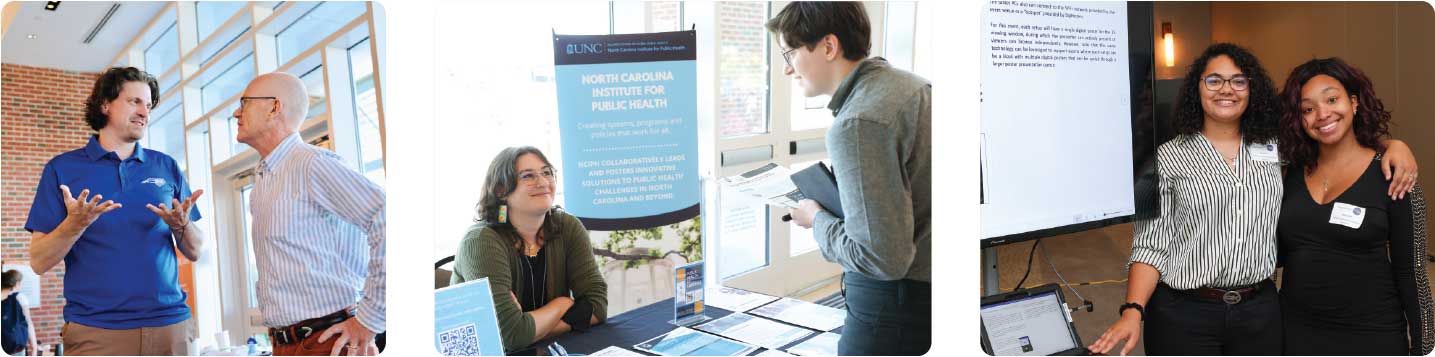
The event brings together public health professionals at all career stages — students, mid-career professionals and retirees — to strengthen practice through connections and strategies that lead to healthier North Carolinians.
It’s where academics meet practice, and Gillings’ collaborative work helps the state’s workforce evolve. More than 20 Gillings representatives — from the North Carolina Institute for Public Health (NCIPH), the Departments of Public Health Leadership and Practice (PHLP) and Maternal and Child Health (MCH), and more — attended the conference to share mission-driven work aimed at building capacity of practitioners and leaders in the public health workforce.
Four priority areas — communications, policy development and support, organizational competencies, and accountability and performance management — have guided statewide collaboration. These capabilities are essential for governmental public health services to deliver protections and programs that improve health. With federal Public Health Infrastructure Grant funding, NCIPH works with N.C. public health agencies to gather data, conduct surveys, develop trainings and provide other support resources to enhance these areas.
Many presentations at this year’s conference drew from this work and covered topics such as:
- Building Leadership Capacity to Strengthen Public Health Infrastructure in N.C. (given by Breyana Davis and Steve Orton)
- Workforce WINS: Early Success from the N.C. Public Health Pathways Program (given by Alexa Katon)
- Mission Driven Onboarding: Building Public Health Capacity Through Foundational Training (given by Lori Rhew and Ellis Matheson)
- Accreditation: Past, Present and Future (given by Margaret Benson Nemitz and David Stone)
- Reporting Alignment Crosswalk for North Carolina Local Health Departments: Change Management in Practice (given by Bridget Nelson and Sara Currin)
- Combatting STIs in Young U.S. Servicewomen: A Systematic Review of Sociodemographic Risk Factors (given by Grace Smolen and Julia Donavant)
The Gillings School was a silver-level sponsor and hosted a table to share program information. Students, staff and faculty presented posters and research. Dorothy Cilenti, DrPH, professor of maternal and child health and director of the National Maternal and Child Health Workforce Development Center, delivered the closing keynote, highlighting collaborations with local health departments.
Several Gillings members and partners were honored for their practice-based work. Lori Rhew and Ellis Matheson received the Academic Practice-based Research (ABPR) Practitioner Oral Presentation Award for foundational public health course development for Buncombe County Health and Human Services, Department of Public Health. Master of Public Health student Grace Smolen earned the APBR Student Poster Award for “Bridging the Gap: Academic-Practice Partnerships to Optimize Resource Registries to Support Veteran Mental Health.”
Additional student posters included:
- Systems Thinking in Public Health Practice: Engaging Communities to Advance Veteran Wellness (Jessica Linger and Maria Guta)
- Cross-Sector Collaboration to Strengthen Systems of Support: Lessons Learned from Phase 1 of the Healthy Vets Community Project (Jessica Linger and Mariangelie Torres-Maldonado)
“A lot of magic can happen in a place like this conference when we have the opportunity to converge in person,” said Amy Joy Lanou, PhD, director of NCIPH and professor of PHLP. “When a leader in the state public health division, a person who’s leading health communications in a specific county and our team member that’s guiding regional health communications all sit at the same table or are discussing somebody’s work in a conference session — that sticks. And then people build on that.”
The week also included a quarterly retreat with local and state practitioners and NCIPH staff, plus a pre-conference session on communication — a growing priority in an age of misinformation. Eight NCIPH representatives and partners presented. Martha Anne Sperandio, MPH, communications project manager, shared updates on a collaborative network supporting health campaigns statewide. “Collaboration and peer-support are key in building capacity for local health departments to effectively communicate trusted messages to North Carolinians they serve,” she said.
Elevating public health practice will continue to play a major role in the Gillings School’s strategic plan, and the NCPHA conference plays a major role in ensuring those in PHLP, NCIPH, MCH and partners across the state create informed strategies about how to improve their work in the community.
1. HeLa cells print
These are HeLa cells, the immortal cell line from Henrietta Lacks. Her cells were taken from her without her informed consent and contributed to groundbreaking research, disease treatments, scientific discoveries and medical patents. It’s important to me to bring awareness to how powerful and significant her life was and to honor her full humanity. She was more than just her cells. She was a mother, a wife, a woman whose life mattered.
2. Motivational mirror and quote wall
The mirror and words remind you that you are here for a unique purpose. Your life is important in the fabric of society and you can make an impact — decide what yours is going to be and then BE IT!!
3. Framed print: "Remember why you started"
This reminds me why I chose this career and love what I do. “Teaching is heart work,” and when challenges arise, it’s my reminder to keep going because I know I make a difference!
4. Student leadership artwork
Students in one of my MPH courses were asked to create a visual representation showing the relationship between key concepts while incorporating leadership skills and self-awareness. These students were very creative, which I loved. It nicely demonstrated their understanding of the course content.
5. Juggling set for beginners
A juggling set for beginners: Linda Kastleman, who was on the Gillings communications team, gave me this special gift when I was a student because I was always doing a lot as a student leader while completing my dissertation. She would encourage me. I often look at this, think of her and smile. I am still juggling a lot, but I have advanced from beginner status!
Where did you grow up?
I grew up in Concord, N.C., and I went to UNC-Chapel Hill for undergrad as a math major. I’m Tar Heel born, Tar Heel bred.
When did you know that public health was your path?
After graduation, I became a Peace Corps volunteer, teaching high school math for two years in northern Namibia, and then staying for a third year as an HIV liaison for the Ministry of Education. The community I lived in had a 25% HIV prevalence at a time before treatment and testing were available. The effects were devastating in the day-to-day lives of my host family and students.
At the end of my second year, I went to a talk where someone was showing the trajectory of life expectancy in Namibia, the economic impacts under the current prevalence, and how that could be changed if HIV treatment was available and was effective. I went up to that person at the end of their talk and said, “What do you do for a living?”, to which they replied, “I’m an epidemiologist.” And from that point, I knew I wanted to go down the pathway of using numbers and math for scientific advocacy.
What are your research interests?
My whole career has been one of advocacy. I try to work in service to organizations that use research to understand health challenges or the impact of interventions. The organization I’ve worked with the most is Partners In Health (PIH). Paul Farmer, the founder of PIH, was my former chair, and I knew I wanted to work for an organization that had such a global impact.
PIH has a cluster of interests and priorities in maternal and child health, and as a result, my research has increasingly focused on the health of women and their children. And now, as an even more specialized subset of that, I study how people can engage digital technologies and AI for improved maternal and child health care delivery, particularly in resource-limited, rural settings. My largest research project is developing and evaluating an AI-enabled mobile health app that supports community health workers to provide post-cesarean care in rural Rwanda.
What do you do to unwind?
Outside of work, my biggest priority is nurturing my family: my partner, my eight-year-old and my ten-year-old. My kids are very adventurous and very creative, which makes me, by extension, very busy! If I truly do have time for myself to unwind, I enjoy West African and Zumba dance classes.
What do you think is the biggest public health issue today?
The biggest threat is trust in public health and the public’s willingness to recognize that public health is a worthwhile investment. The challenge with public health is that when you do it really well, you don’t actually see the benefits, because it just permeates everything. And when you pull out that investment, you see the consequences but may not necessarily draw the line between the consequences and that lack of investment. So, I am challenged by questions like: How do I advocate to my friends that they should continue to vaccinate their kids? How do I advocate to my community that they need to support public health boards? Or how do I advocate to my government that we need to continue to invest in public health research?
———
Congratulations, new distinguished professors!
Stephen Cole, PhD
Cary C. Boshamer Distinguished Professor, Epidemiology
Dr. Cole is a leader in causal inference and epidemiologic methods, advancing research that improves the accuracy and reliability of public health evidence.
Jason Surratt, PhD
Cary C. Boshamer Distinguished Professor, Environmental Sciences and Engineering
Dr. Surratt studies how air pollutants form and transform, deepening understanding of atmospheric chemistry and its effects on human health.

Hongtu Zhu, PhD
Kenan Distinguished Professor, Biostatistics
Dr. Zhu develops innovative statistical and imaging methods that drive discoveries in genetics, neuroscience and precision medicine.
Located in Cumberland, Durham, Halifax and Jackson counties, these hubs provide resources and expertise to bolster local public health efforts. Faculty, staff and students collaborate with community organizations on projects that address each county’s unique health priorities.
The Hubs also offer practicum opportunities — summer or semester-long internships — for Master of Public Health students to apply classroom knowledge in real-world settings. Several first-year MPH students completed their practicum work in hub counties this year and shared insights from their experiences.
Practicum opportunities let MPH students put their public health education into action and discover what the practice of public health looks like outside the classroom.
Cumberland County
Aisha Siddiqi, health policy and management
Siddiqi worked with the Southeastern N.C. Healthy Start program, supported by public health departments in Cumberland and Hoke counties. Healthy Start provides resources such as baby carriers, classes and educational materials to new parents. Siddiqi and fellow student Shannon Micklewright created social media campaigns and marketing materials to connect new mothers with program offerings online.
Durham County
Anna Gilbert, health behavior, dual MD/MPH
Gilbert partnered with the Durham Center for Senior Life, focusing on funding strategies, building a grants database and drafting applications. She also conducted a mixed-methods impact evaluation — including a literature review, survey design and participant interviews — to assess the center’s effect on physical activity and quality of life.
Aaliyah Goodman, applied epidemiology
Goodman evaluated Duke University Hospital’s Violence Recovery Program, which links victims of violence to community resources such as mental health care, education and housing. She analyzed demographic and injury data, along with resource connections up to a year post-discharge, to help improve program services.
Jacob Woodford, public health data science
Woodford collaborated with Durham County to enhance air quality tracking by integrating an Air Quality Index API into the county website. He also assisted with a community health assessment, collecting survey data at a local farmers market, and said the experience highlighted the symbiotic relationship between public health departments and communities.
Halifax County
Krishanda Sue Lucas, nutrition
Lucas developed a feasibility plan and grant materials for a commercial kitchen at the Hattie Palmer Staton Senior Center in Scotland Neck. The project aims to expand senior meal preparation and delivery and strengthen food access countywide. Lucas assessed infrastructure needs, regulatory considerations and funding strategies.
Samantha Schild, global health
Schild worked with the Rosalene M. Moore Cancer Awareness Foundation, known locally as the Fighters Foundation, to support cancer patients in Halifax, Northampton and Nash counties. She created a long-term work plan for establishing a hospice care facility, researched funding opportunities, contributed to a grant proposal and drafted a press release to attract community support.
Francesca Walker, health behavior
Walker partnered with Halifax County’s health director to assess health priorities and barriers to care in rural communities. She reviewed needs assessments and strategic plans, identifying gaps in vaccination rates and telehealth access for veterans.
Jackson County
Isabel Cody, health behavior
Cody worked with the Jackson County Department of Public Health to create a tobacco cessation presentation for county employees, later converted to video. She also helped design a survey on loneliness and isolation to determine whether these issues hinder community engagement.
Leah Maness, applied epidemiology
Maness, an MPH@UNC student, collaborated with Friends of the Jackson County Greenways to survey residents about greenway use and motivations. She compiled findings into a 30-page report incorporating health assessment data, which supported grant applications for greenway expansion by demonstrating community support and health benefits.
———
Through these practicum experiences, Gillings students strengthened local health systems while gaining practical skills to advance public health across N.C.
What’s your role in public health?
I’m a senior studying health policy and management at the Gillings School. I want to be a physician and policy maker, and I chose public health because it’s highly interdisciplinary. In my future career, I see myself working in clinical spaces, insurance, hospital administration, and local and federal policy — across the health care ecosystem. I want to combine perspectives from them all to approach public health challenges in dynamic ways.
Can you describe your focus area in one sentence?
I want to be a bridge builder.
Right now, I see chaos at the federal level and know we must rebuild trust in public health. Health moves at the speed of trust, and people are full of doubt.
I grew up moving between four states — Iowa, California, South Carolina and Alabama — which exposed me to diverse social and political climates. That taught me the value of forming relationships with all kinds of people.
It’s easier to condemn than to understand. Empathy is essential, and it’s strengthened by first-hand experiences — living and witnessing things, not just reading about them. That’s why I want to occupy many spaces in public health. I want to look at the people I’m serving and honestly say, “I do understand.”
What brought you to public health?
I’ve been interested in medicine since ninth grade. COVID arrived when I was in tenth grade, the first time I’d heard of public health. In my last two years of high school, I did a capstone project on education and how socioeconomic factors impact access and outcomes.
My interest was based on lived experience: I was the only Black male in all seven of my Advanced Placement classes, even though Black students made up 30% of my high school — the largest in Alabama.
Living through a pandemic showed me that health and well-being are affected by the same social determinants that impact education.
Can you describe a time when you’ve pivoted in your public health career?
As a Black male in the South, I’ve always been passionate about health equity. More recently, I’ve realized I want to improve equity by driving innovation in health financing and care delivery. This approach requires making public health reforms financially viable. That’s how we empower health systems to move equity from a value to a sustainable practice.
We’ve identified social determinants of health, but solutions remain elusive. Why? Some say you must fix housing, education and environmental issues before public health can be equitable, and those are huge tasks.
Instead of tackling these separately, I believe we should redesign incentives within health systems, shifting focus from health care to overall health. Traditionally, our model rewards treating sickness over promoting health.
I’m excited about shifts from fee-for-service to value-based care, which rewards providers for outcomes and quality rather than volume. I’m inspired by technology and care management approaches — enabled by value-based incentives — that prioritize prevention and reduce unnecessary procedures. These trends offer actionable pathways toward equity today.
Who are you when you’re at home?
I stay busy! I’m a Rhodes and Morehead-Cain Scholar, two-time Jeopardy contestant, and UNC’s senior class president. Friends call me a workaholic, but I love being active and lazy in turn.
Sometimes, I’m playing intramural soccer or training for the Potomac River Run Marathon. Other times, I’m binge-watching shows like Severance, Hacks and Derry Girls.
Community is a top value. I’ve had generous mentors, and I believe meritocracy is a myth; achievement is talent plus serendipity. I try to pay it forward by sharing college admissions and scholarship advice on TikTok, where I have about 39,000 followers. One viral video about my own scholarship success — more than $2 million across 11 schools — drew thousands of questions. To help, I created videos and launched meritscholarships.org, a national directory of merit-based scholarships.
———
More Pivot interviews:
sph.unc.edu/comm/the-pivot
Highlights from our work in practice:
- Leading Regional Emergency Preparedness: In partnership with the CDC, Gillings was awarded the Region 4 Center for Public Health Preparedness and Response. The Center is building capacity across eight southeastern states, including launching an intervention to help emergency response agencies address harmful health rumors.
- Activating the Public Health Partnership Hubs: The four pilot Hubs in Cumberland, Durham, Halifax and Jackson counties are now fully operational (see Partnership Hubs article). Hub coordinators have connected with more than 50 community partners and supported more than 15 projects and classroom collaborations. Gillings students contributed 4,800+ hours of practice work, supporting community events, organizing focus groups and integrating community voices into coursework.
- Engaging Students: Seventeen Master of Public Health students have completed practica and internships through the Hubs, strengthening local public health infrastructure while gaining hands-on experience.
- Strengthening Academic Health Departments (AHDs): Gillings has formalized collaboration agreements with the N.C. Division of Public Health and is launching an acceleration project to support local health departments interested in creating their own AHDs.
For more information on practice at Gillings, visit: sph.unc.edu/practice/practice-and-service
Looking ahead
In the coming year, the practice unit will:
- Embed and Elevate Public Health Practice: Continue embedding students, faculty and staff into community-based and government organizations in the four Hub counties to address local health priorities.
- Advance Practice-Based Research: Collaborate with the Gillings Research Strategic Plan to strengthen evidence-based solutions.
Together, these efforts keep us moving forward in our commitment to elevate practice alongside research and teaching.
Widening our impact
Gillings faculty and students are actively shaping public health outcomes across N.C. and beyond. Their practice work addresses urgent needs (ranging from disaster preparedness to food access) while advancing health equity for communities locally and globally.
- About 70% of faculty engage in impactful practice work across N.C. counties and globally.
- Beyond practicum, 10% of students contribute to public health efforts at county, state and international levels.
Effective communication builds public confidence, counters misinformation and ensures that vital resources (such as vaccines, treatments and preventive measures) are used appropriately. It ensures diverse audiences receive messages tailored to their needs from community members who they trust. In times of crisis, strong public health communication can mean the difference between widespread harm and a coordinated, effective response.
Top articles
- There’s a Right Way—and a Wrong Way—to Snack | The Wall Street Journal, July 8, 2024
- What a geriatric doctor wishes you knew now for healthy aging | CNN Health, July 12, 2024
- Four foods that should come with a smoking-style health warning | The Telegraph, July 29, 2024
- Fact-checking Kennedy’s health claims in his confirmation hearing | NY Times, January 29, 2025
Media Mentions
Gillings experts were quoted or mentioned in more than 250 media articles on many topics, including health policy, COVID-19, nutrition, alcohol use, vaccination, environmental health and food regulations. Top outlets include NC Health News, NPR, The New York Times and The Daily Tar Heel.

In total, $18,183,445 was raised in FY25. These gifts created 11 new funds, including 4 endowed funds that will provide long-term stability and 7 expendable funds that offer immediate support where it’s needed most.
Donors also helped launch 2 new scholarships, fellowships or student support funds and established 3 new professorships or faculty support funds. These investments strengthen the student experience and reinforce the School’s ability to recruit and retain outstanding faculty.
As of October 6, current fiscal year fundraising totals stand at $5,184,544, with a goal of reaching $20 million by the end of the fiscal year. This momentum reflects a shared commitment to advancing education, research and community impact across North Carolina and beyond.

“I took to it like a duck to water,” he said. “Being able to take the math and point things in a direction that can really make a difference and help people — that was a need I hadn’t realized I had.”
A drive to be of service, exemplified by his mother, Dr. Sue Hollowell Lee, runs deep in Lee’s family. She began medical school with three children under the age of six, completing an accelerated program and launching a pediatric career defined by compassion.
“She works her tail off, and she’s crazy smart,” said Lee. “But being a doctor was never about recognition; it was this almost obsessive need to be of service to other people in her community.”
Dr. Lee focused her practice on children with complex needs, especially those in communities underserved by pediatric medicine. When she returned to her home county in rural North Carolina, she opened its first pediatric clinic, even though she knew it would barely break even. The clinic she started is Pamlico County’s lone federally qualified health center (FQHC) providing comprehensive and affordable care to residents. She would go on to found Heartworks, a nonprofit organization with a mission focused on addressing the underserved mental and physical health needs of youth and their families in Pamlico County and surrounding areas. The organization offers afterschool and summer programs to more than 250 students each year, among other programs.
To honor his mother’s inspiring story and contribute to a legacy of service, Lee endowed the Dr. Sue Hollowell Lee Scholarship in Maternal and Child Health at the UNC Gillings School of Global Public Health, noting the pride he feels in doing so while she is still actively engaged.
“Scholarship in maternal and child health will serve the same things she spent her life trying to serve,” said Lee. “It’s going to help more kids have a shot at a productive and happy life.”
He hopes the scholarship can also bring attention to the challenges that continue to face rural communities, both in N.C. and elsewhere, and to entities like Heartworks and organizations like FQHCs that develop solutions to improve health and well-being.
By establishing this fund, Mark Lee is investing in the future of public health and the drive to uplift underserved communities, ensuring one woman’s extraordinary legacy continues to inspire generations to come.
———
Contact the advancement team at UNC Gillings to discuss how you can build an enduring legacy at our School: email.sph@unc.edu
No results found
There are no results with your selected criteria.
Try changing your search.
